



When I saw the “Pass” result for the CSSLP exam, my first reaction wasn’t excitement.
It was relief.
And then — clarity.
CSSLP wasn’t just another certification to add to my profile. It was a mirror held up to my career, forcing me to confront how often security is treated as an afterthought, a patch, or a gate — instead of a design principle.
This is the story of why I pursued CSSLP, how I prepared for it, and what it quietly changed in the way I think about software and security.
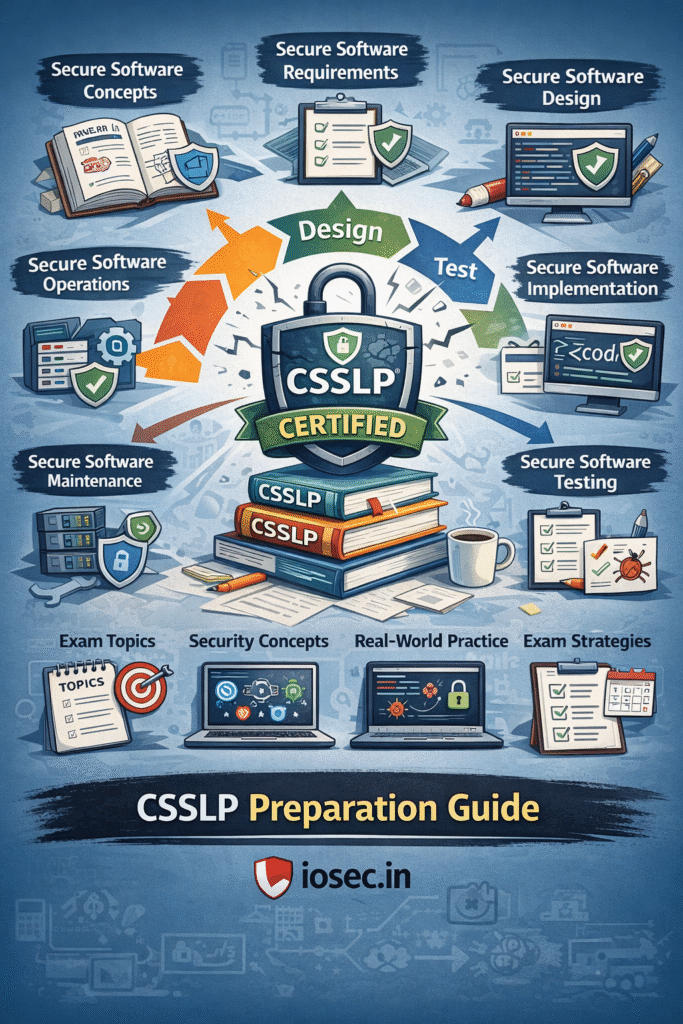
Why CSSLP Was Different for Me
Over the years, I’ve worked across multiple areas of cybersecurity — penetration testing, Red teaming, incident response, threat analysis, governance. I’ve seen breaches up close. I’ve watched teams scramble after vulnerabilities were discovered too late.
And a pattern kept repeating.
The problem wasn’t a lack of tools.
The problem wasn’t lazy developers.
The problem was how systems were designed in the first place.
CSSLP appealed to me because it focuses on the why and when of security — not just the how.
In short: security as engineering discipline, not emergency response.
The Emotional Side No One Talks About
Preparing for CSSLP was intellectually demanding — but also humbling.
Many questions made me pause and think:
- Why do we still treat threat modeling as optional?
- Why is security invited only after architecture is finalized?
- Why do we measure success by vulnerabilities found, not vulnerabilities prevented?
There were moments when I realized:
“I’ve seen this mistake in real systems… and I’ve accepted it as normal.”
CSSLP doesn’t let you hide behind tools or titles.
It asks you to take responsibility for design decisions — even the uncomfortable ones.
Understanding What CSSLP Really Tests
CSSLP is not about:
- Writing secure code
- Finding vulnerabilities
- Exploiting flaws
It tests whether you understand:
- Where security belongs in the SDLC
- Which phase offers the lowest cost of remediation
- How to balance security, usability, and delivery
- How to design systems that fail safely
Most questions are not “right vs wrong”.
They are “best possible decision” questions.
And that’s exactly how real-world security works.
Exam Strategy
This is a 3-hour exam with no option to review previous questions. You’ll have 180 minutes to answer 125 questions, which works out to roughly 1.4 minutes per question. Some questions will be quick, while others will require more thought — so effective time management is essential.
Below are the strategies I personally use when taking ISC2 exams, which helped me stay calm and make better decisions under time pressure.
How to Read and Break Down Exam Questions
When working through each question, I approach it in a structured way to narrow down the best answer:
1. Read strategically, not linearly
I start by quickly scanning the question, then skim through all the answer choices. Once I have context from the options, I go back and carefully re-read the question to understand exactly what it is asking.
2. Eliminate obvious wrong answers first
Any option that is clearly incorrect gets removed immediately. With fewer choices remaining, it becomes much easier to focus on what the question is truly testing.
3. Watch for answers that subsume others
Sometimes one option is broader and includes the meaning of multiple smaller options. In such cases, the broader and accurate choice is usually the best answer.
Pay Attention to Process-Based Questions
Many ISC2 questions are designed to test whether you understand process and sequence, not just technical solutions.
If a question asks “What should be done next?”, it is often checking whether you know the correct order of actions rather than the final fix.
Example scenario:
A firewall administrator observes internal traffic attempting to connect to an unfamiliar external system in another country. What is the most appropriate next action?
Possible responses might include blocking traffic, scanning the system, or disconnecting the device. While these actions might eventually be necessary, they are premature without understanding what is happening.
The correct response is typically to document and analyze the activity first. Acting too aggressively without sufficient information can unnecessarily disrupt business operations, especially if the system involved is critical.
Focus on Answers That Truly Address the Question
It’s common to see multiple answers that sound correct — but only one actually responds to the question being asked.
Keep in mind:
- An answer can be factually correct but irrelevant to the question
- An answer may sound detailed and impressive, yet miss the core point
- Precision alone doesn’t make an answer correct — accuracy and relevance together do
How I Prepared (Without Burning Out)
I avoided the trap of over-collecting resources. Instead, I focused on core principles and repeatedly mapped them to real experiences.
My Study Approach Was Simple:
- Understand the intent behind security controls
- Focus on prevention over detection
- Always ask: “How early could this have been addressed?”
Key Resources That Truly Helped
I won’t list everything — only what genuinely mattered.
ISC2 CSSLP CBK
Not for memorization — but to understand:
- Scope
- Terminology
- Domain boundaries
NIST Secure Software Guidance
- NIST SSDF
- NIST SP 800-64
These helped me understand secure SDLC at organizational scale, not just project level.
But the most important resource was reflection:
Mapping concepts to incidents I had lived through.
The Biggest Shift: Thinking Like a Designer, Not a Fixer
Before CSSLP, my instinct was often:
“How do we fix this vulnerability?”
After CSSLP, my instinct became:
“Why was this possible in the first place?”
That shift alone is worth the certification.
CSSLP trains you to:
- Think upstream
- Influence architecture
- Ask better questions
- Push security earlier — without blocking delivery
Exam Day: Calm Comes from Clarity
On exam day, I wasn’t trying to remember facts.
I was asking:
- What is the earliest control?
- What reduces systemic risk?
- What decision scales?
That mindset carried me through.

When I finished the exam and saw the result, it felt less like “passing a test” and more like closing a loop — between experience, intuition, and structured thinking.
What CSSLP Gave Me (Beyond a Credential)
CSSLP didn’t make me a better pentester.
It made me a better:
- Reviewer
- Architect
- Advisor
- Security partner to engineering teams
It strengthened my belief that:
The strongest security teams don’t say “no” — they design safer paths forward.
Who I’d Recommend CSSLP To
CSSLP is ideal if you:
- Work in application security
- Influence SDLC decisions
- Design or review architectures
- Want to move from reactive security to preventive security
- Care about long-term risk reduction
It’s not for those looking for:
- Exploits
- Tool-heavy labs
- Short-term wins
CSSLP rewards patience, judgment, and responsibility.
Final Reflection
Passing CSSLP felt personal.
It validated a philosophy I’ve believed in for a long time:
Security is not something you add.
It’s something you design.
If you’re considering CSSLP — take it seriously.
Not because it’s hard, but because it asks you to think deeply.
And that kind of thinking stays with you long after the exam is over.

Special Call-Out
Prabh Nair’s YouTube resources are extremely useful for CSSLP preparation because they break down Secure SDLC concepts in a simple, exam-oriented, and experience-driven way.

One thought on “CSSLP: A Journey of Relearning How Security Should Be Built”